Forest of Avon

6.5 LCT E: Limestone Ridges and Combes
The map below shows the location of LCAs with LCT E: Limestone Ridges and Combes - View map full screen
For help on how to use this map click here.
Landscape Character Type description
A series of elevated limestone ridges with wooded scarp slopes which form a visually prominent backdrop to surrounding lower-lying landscapes. This LCT occurs across North Somerset, encompassing rural and suburban landscapes. Part of the LCT (LCA E1: Mendip Ridges and Combes) falls within the Mendip Hills National Landscape.
Within North Somerset, LCT E comprises LCA E1: Mendip Ridges and Combes, LCA E2: Worlebury Ridges and Combes, LCA E3: Middlehope Ridges and Combes, LCA E4: Portishead Ridges and Combes, LCA E5: Tickenham Ridges and Combes, and LCA E6: Cleeve Ridges and Combes, as described in the North Somerset LCA (2018), and shown on the mapping provided.
Existing tree and woodland coverage
Woodland cover is relatively high across the Limestone Ridges and Combes LCT, comprising almost 40% of the total land cover. Woodland cover is higher in LCAs E5 and E6 (44%) and lower in LCA E3 (10%). 11.7% is ancient woodland (dominated by oak and ash, with frequent small-leaved lime and wild service trees) with extensive areas in LCAs E1, E4 and E6 designated as SSSIs and Local Wildlife Sites. This is a well-wooded LCT with large areas of mixed and broadleaved woodland, often situated on the steeper slopes and combes. There is a large conifer plantation at Brockley Combe (LCA E6). Frequent hedgerow trees, occasional in-field trees, trees in golf courses (LCA E2 and E4), and ornamental species within historic parks (LCA E5 and E6) further contribute to the wooded character of the landscape. Some traditional orchards remain around settlements and farms (notably in LCAs E1, E4, E5 and E6).
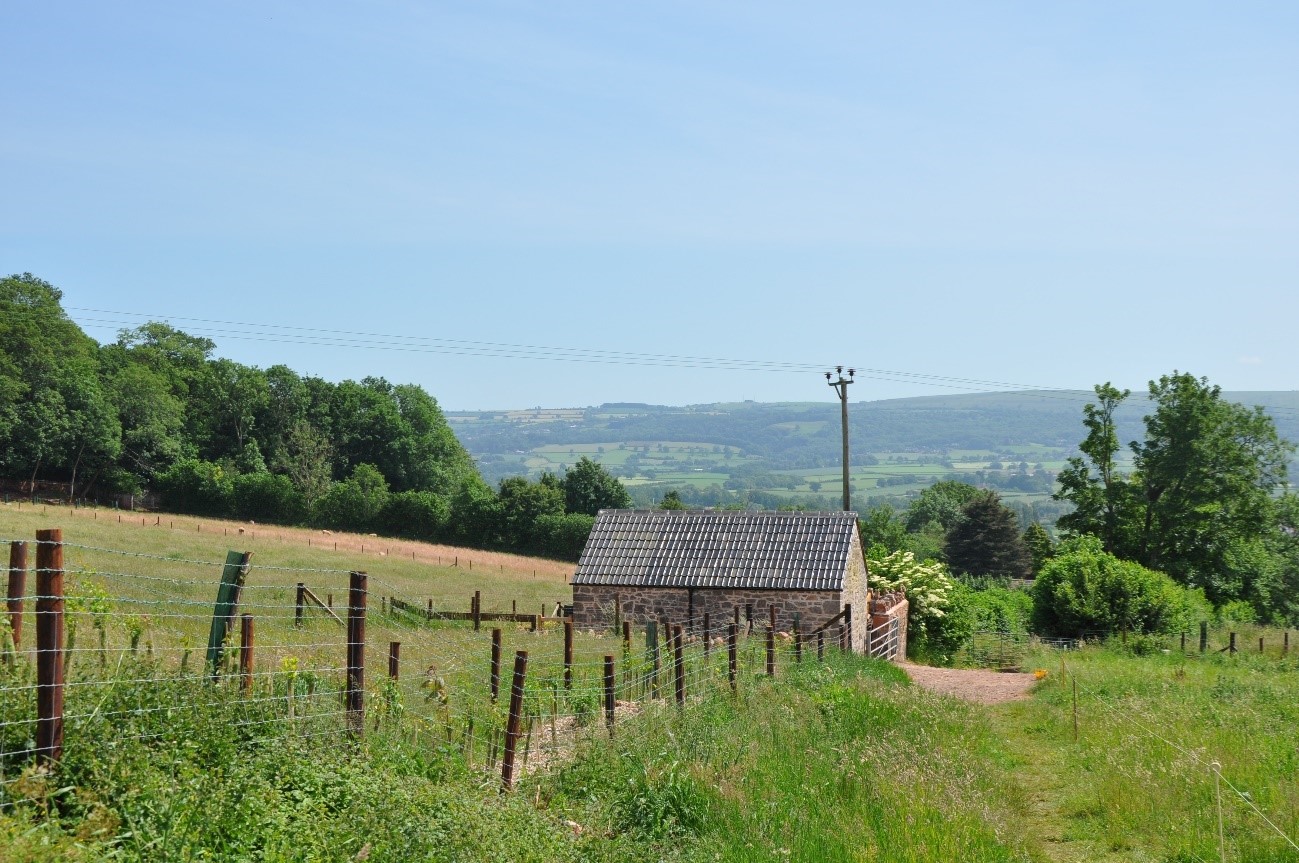
View south from Cleeve Ridge (LCA E6) towards wooded Mendip Ridge (LCA E1) within the Mendip Hills National Landscape.
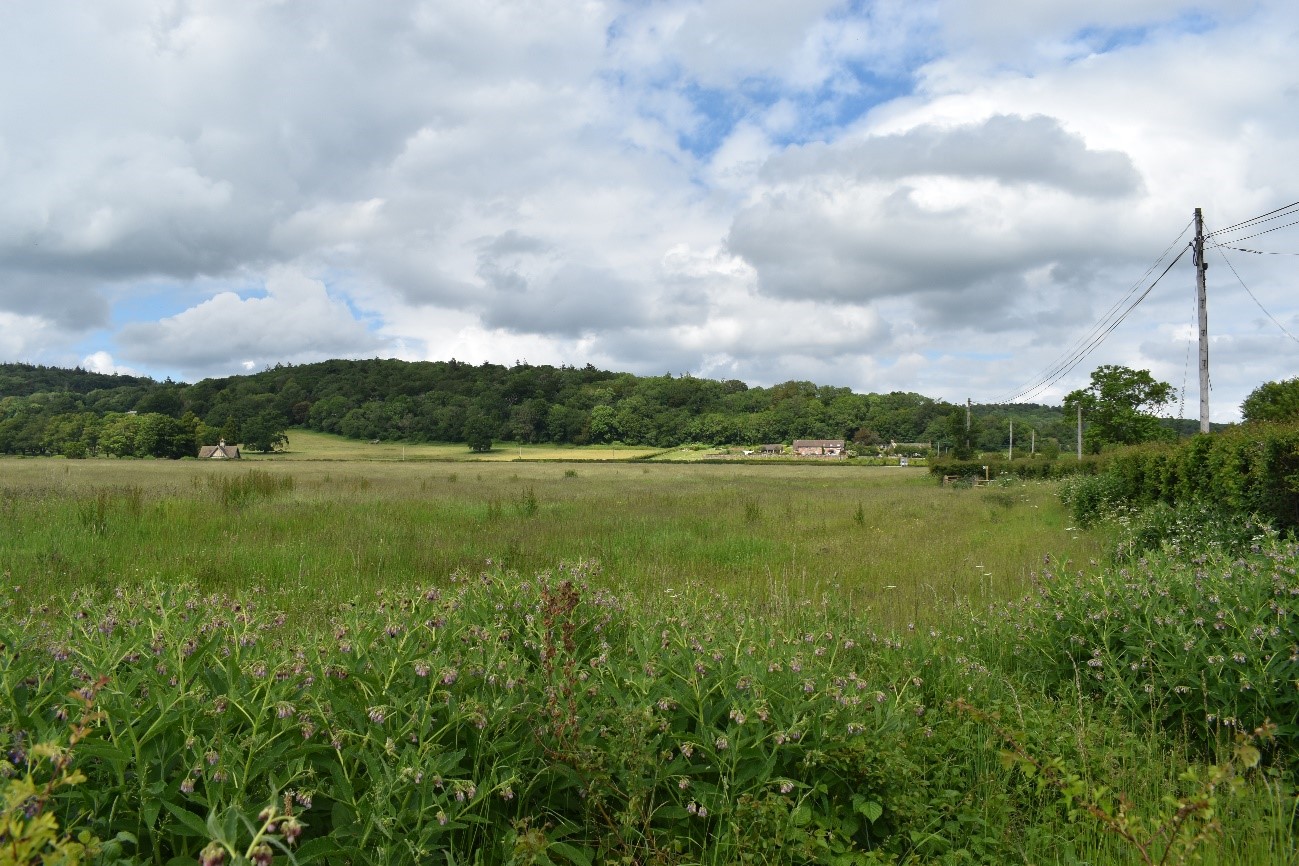
Views towards the wooded Tickenham Ridge (LCA E5) from the Land Yeo and Kenn River floodplain (LCA B1).
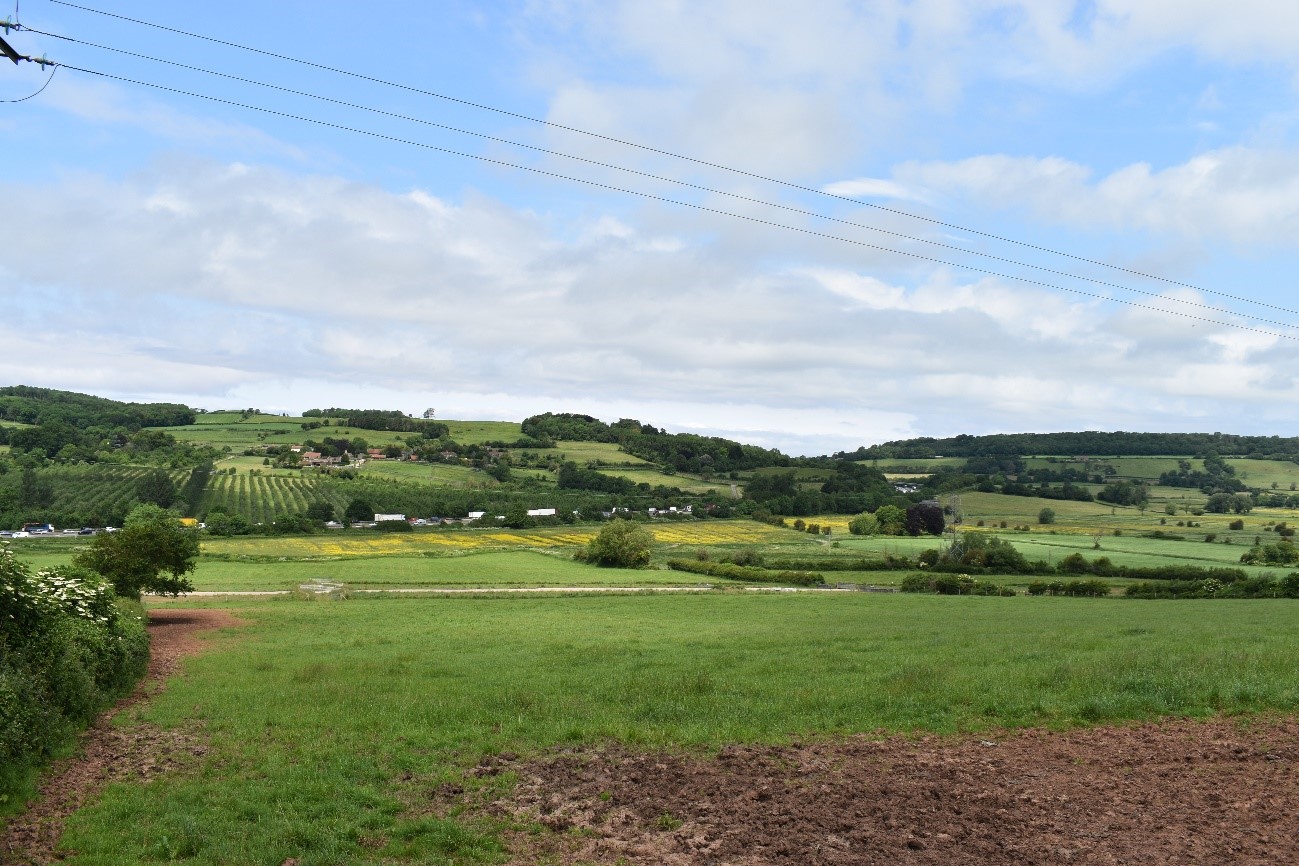
Woodland cover on Bleadon Hill (LCA E1) comprises scattered woodland blocks and a commercial orchard.
Land cover composition of LCT E
There was an issue displaying the chart. Please edit the chart in the admin area for more details.View and export full results.
Landscape sensitivities
Landform (including scale and pattern)
- A large-scale landscape of prominent limestone ridges with steep slopes incised by deep combes. New woodland planting aligned with the contours of the landform could complement the scarp slopes and incised combes, taking care to retain the distinctive open ridgelines.
- The steep, unwooded cliffs along the Severn Estuary (LCA E3 and E4) would be sensitive to new woodland planting of all sizes which could mask these distinctive landform features.
Field and landcover pattern
- Lower slopes are characterised by small to medium-scale pasture fields bound by hedgerows with hedgerow trees. This landcover pattern could be reinforced by small-scale woodland planting , while larger-scale planting could alter the landscape structure, increasing sensitivity.
- Fields on the elevated ridge tops within the Mendip Hills National Landscape (LCA E1) comprise large-scale, regular fields of open grassland bound by drystone walls, and are a distinctive characteristic of the Mendip Hills National Landscape which would be sensitive to change.
- Semi-natural grasslands characterise the ridge tops. These habitats (many designated as SSSI) are sensitive to woodland expansion, which could result in a loss of landscape and habitat diversity.
- A well-wooded LCT, with extensive ancient woodland, often aligning along the contours of the scarp slopes. New woodland (up to medium-sized) could enhance the existing structure and connectivity with woodland in adjacent LCTs.
Historic landscape character
- Extensive historic field patterns of medieval origin on lower slopes and post-medieval origin on upper slopes and ridge tops are sensitive to woodland expansion that could mask the historic landscape pattern.
- Historic assets ranging from prehistoric barrows and skyline hill forts, a Roman camp, a medieval village, and motte-and-bailey castle, indicate higher sensitivity to woodland planting that could impact on their setting.
- Historic parkland in LCA E5 (Clevedon Court, parts of Ashton Court and Tyntesfield) and LCA E6 (Barley Wood and Barrow Court) are sensitive to woodland planting that could mask distinctive features, enclose designed views, or impact their setting.
Visual character (including skylines)
- Expansive views from the open ridge tops over surrounding valleys and from coastal areas to the Severn Estuary, would be sensitive to woodland planting of medium-large size that would enclose outward views.
- Views to and from the Mendip Hills National Landscape (LCA E1), including key viewpoints such as Bleadon Hill, would be particularly sensitive to new woodland planting.
- Notable landmarks, including a former windmill (LCA E1) and local church towers in villages are sensitive to woodland planting that could impact their setting or visual significance.
Perceptual and scenic qualities
- A scenic rural landscape with a sense of remoteness and a pleasing combination of features which would be sensitive to change. This includes exposed ridges, open grasslands, secluded wooded coombes, pastoral slopes, estate parklands, intact hedgerows, drystone walls and historic stone villages.
- Urban areas in adjacent LCTs, including Clevedon and Portishead limit the sense of tranquillity in the LCT (notably in LCAs E2 and E4). Small-scale new woodland planting could screen unsympathetic urban edges and integrate urban fringe and coastal developments, including golf courses (LCA E2) and caravan parks (LCA E4).
- LCA E1 is located within the Mendip Hills National Landscape where the special qualities of the protected landscape (including flower-rich grasslands, extensive views and distinctive ridges) would be sensitive to change. However, smaller-scale woodland may present opportunities to enhance the landscape structure.
Assessment of landscape sensitivity to tree and woodland planting
Summary
Small and small-medium-sized woodland is typical of this landscape and could generally be accommodated across the LCT. New woodland planting of this size could reinforce the existing field patterns, and complement and extend the existing pattern of small to medium-sized woodland blocks and copses, hedgerows and hedgerow trees, as well as enhance connectivity between the network of semi-natural woodland and grassland habitats. New planting should avoid masking , distinctive characteristics of the Mendip Hills National Landscape (LCA E1) including the drystone wall field boundaries.
Medium-sized broadleaved and mixed woodlands are typical of this LCT. New planting up to medium-sized woodland could provide opportunities to enhance woodland connectivity across the LCT, and with the adjacent moors and valleys landscapes. As set out in The Forest of Avon’s Tree and Woodland Strategy, strategic new small-medium woodlands could bridge the “Star Gap” and “Sanford Gap” (LCA E1), strengthening the woodland corridor on the northern edges of the Mendip Hills. Similarly, there are opportunities to create new woodlands across the “Aldwick Gap” (LCA E1 and LCA E6) to link to existing woodlands in LCA G1 (Broadfield Down Plateau) and J2 (River Yeo Rolling Valley Farmland) to form a continuous wooded corridor between Wrington, Congresbury, and Flax Burton. Although ancient woodland on slopes and combes are sensitive to the introduction of new woodland planting, there is an opportunity to strategically connect these areas with newly established woodlands of similar species composition. Woodland of this size should be carefully sited to avoid masking the existing small-medium scale and irregular field pattern, some of which is medieval in origin, or enclosing the open skylines of the ridge tops and views from these elevated areas Other semi-natural habitats, particularly species-rich grassland on ridge tops, would be sensitive to new woodland of this type. Medium-sized woodlands could also screen settlement edges and suburban land uses, notably in LCA E2 and LCA E4.
Large woodlands are typical of this landscape, occurring on the ridge slopes and within combes. There may be potential to extend existing smaller areas of woodland to create new large-size woodlands, however, the introduction of new ‘standalone’ woodlands of this size would be largely unsuitable across the LCT as it could mask the small-scale historic field patterns, alter the characteristic pastoral landscape of the lower slopes and enclose open skylines of the ridge tops, and potential reduce the extent of semi-natural grassland habitats and ancient woodlands. Historic estates would be sensitive to large-scale new woodlands which could detract from parkland style planting (LCA E5 and E6).
There is an existing commercial conifer plantation in LCA E6. However, the introduction of further commercial-scale conifer plantation is unlikely to be able to be accommodated across most of LCT. There may be opportunity to extend existing commercial conifer plantations in LCA E6 into the slopes of LCA E5, buffered by broadleaved woodland.
Any variations in landscape sensitivity
LCA E1: Mendip Ridges and Combes would be more sensitive to new woodland planting due to its location within the Mendip Hills National Landscape. This elevated landscape is a distinctive landform feature in views from surrounding areas and forms a rural backdrop in views from nearby settlements. New woodland planting should be designed to reflect and enhance the characteristic features while conserving the special qualities of the National Landscape, including broadleaved ancient woodland, rich archaeological and geological sites, pastoral farmland with full hedgerows, and historic farmsteads.
LCA E3: Middlehope Ridges and Combes is particularly sensitive to new woodland planting. LCA 3 would be particularly sensitive to extensive woodland planting which would enclose the exposed character and open skylines, impeding views of the sea and the Welsh coastline.
LCA E4: Portishead Ridges and Combes and LCA E2: Worlebury Ridges and Combes would have slightly lower sensitivity to new woodland planting, which could be used to screen unsympathetic urban edges and suburban land uses. Any new woodland planting in LCA E4: Portishead Ridges and Combes should be designed to avoid screening views towards the Severn Estuary and beyond to Wales.
LCA E6: Cleeve Ridges and Combes would be less sensitive to new woodland planting due to the existing extensive woodland coverage. New broadleaved woodland planting could help to assimilate conifer plantations into the landscape, as well as enhancing connectivity with woodland in adjacent LCTs.
| Criteria | Small size native woodlands and trees outside woodlands (≤5ha) | Small-medium size native woodlands (>5 to 15ha) | Medium size native or mixed woodlands (>15 to 30ha) | Large size native or mixed woodlands (>30ha) | Medium-large size conifer plantation (>15ha) |
| Landform (including scale and pattern) | Low | Low | Low-Moderate | High | High |
| Field and landcover pattern | Low | Low-Moderate | Moderate | High | High |
| Historic landscape character | Low | Low-Moderate | Moderate | High | High |
| Visual character (including skylines) | Low | Low-Moderate | Moderate | Moderate-High | High |
| Perceptual and scenic qualities | Low | Low-Moderate | Low-Moderate | High | High |
| Overall score | Low | Low | Moderate | Moderate | Moderate-High |