Forest of Avon

6.8 LCT H: Settled Hills
The map below shows the location of LCAs with LCT H: Settled Hills - View map full screen
For help on how to use this map click here.
Landscape Character Type description
Located on the eastern edge of North Somerset, this LCT comprises a large undulating plateau, with steep sides incised by narrow spring valleys which fall steeply down to the gentle landform of adjacent LCT J: Rolling Valley Farmland.
Within North Somerset, LCT H comprises LCA H1: Dundry Settled Hill, as described in the North Somerset LCA (2018), and shown on the mapping provided.
Existing tree and woodland coverage
Woodland cover is low across the LCT, comprising 4% of the overall landcover, mostly consisting of broadleaved woodland, with some mixed conifer in the north-west of the LCT. There is no ancient woodland. The pattern of woodland cover is mostly restricted to the narrow spring valleys , with Manning Wood in the north-east being the largest example of this. There is a consistent framework of clipped low hedgerows across the agricultural landscape, with small wind-formed hedgerow trees a key landscape feature clearly visible along the ridgeline.
Expansive, open views north from Dundry Hill towards Bristol.
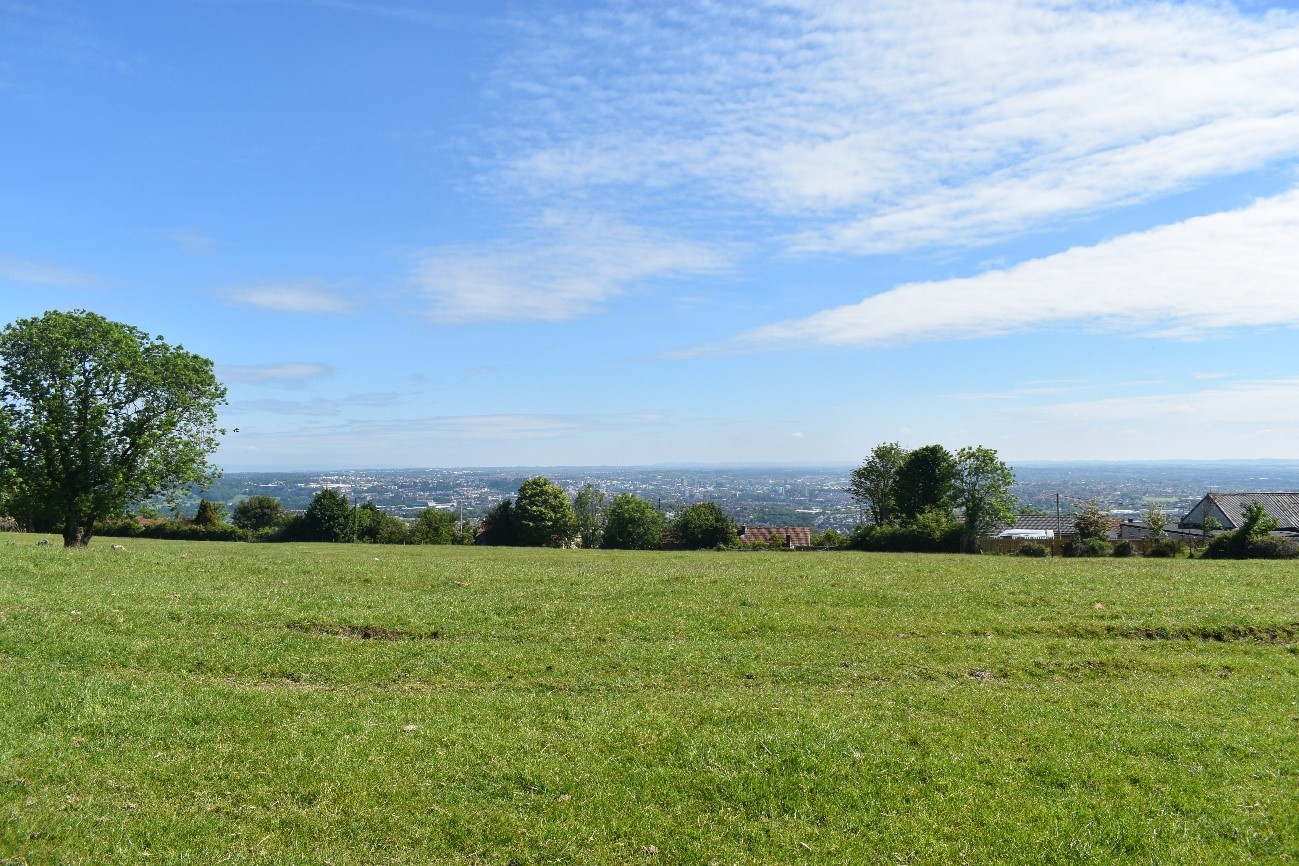
Views across the lower slopes of Dundry Hill showing the open pastoral landscape, interspersed with hedgerow trees.
Land cover composition of LCT H
There was an issue displaying the chart. Please edit the chart in the admin area for more details.View and export full results.
Landscape sensitivities
Landform (including scale and pattern)
- An elevated, large-scale landform with steeply sloping sides that rises dramatically from gently rolling farmland in the surrounding LCTs.
- Shallow valleys formed by springs create undulations in the steep hillside. New small-medium scale woodland planting could complement and enhance the undulating landform, for example through linear planting aligned with the stream valleys.
Field and landcover pattern
- Landcover is predominantly pastoral, comprising irregular small-medium fields enclosed by low clipped hedgerow on lower slopes, and drystone walls higher up. New small-scale woodland planting could enhance the hedgerow network, whilst maintaining the locally distinctive drystone walls.
- Large areas of semi-improved and lowland calcareous grassland priority habitats (many Local Wildlife Sites) would be sensitive to woodland planting unless carefully located to reinforce the habitats mosaic of grassland, hedgerows and small copses.
Historic landscape character
- The landscape retains medieval field patterns and prominent historic features such as the medieval Church of St Micheal (Grade I listed) at Dundry which are sensitive to being masked by new woodland planting.
Visual character (including skylines)
- Low vegetation cover results in a strong sense of openness and exposure across the pastoral landscape. This visual character is sensitive to change from medium-large scale woodland planting.
- Dundry Hill is visually prominent with undeveloped skylines and strong intervisibility between the LCT and surrounding areas, including the Mendip Hills National Landscape. These visual relationships are sensitive to woodland planting which could enclose views to and from the LCT.
- The Church of St Michael at Dundry forms a prominent landmark on the skyline. New woodland planting could screen these key views.
Perceptual and scenic qualities
- An elevated, windswept landscape with a strong sense of openness and exposure that would be sensitive to enclosure by woodland expansion.
- This LCT has a scenic rural character of pastoral fields with small, nucleated settlement and scattered farms connected by a network of rural narrow lanes.
- The perception of remoteness is limited by the visual influence of the urban edge of Bristol as well as  peri-urban land uses (including a scrap yard, industrial scale farm buildings and communications masts). Woodland planting could enhance rural character by screening views to these detracting features.
Assessment of landscape sensitivity to tree and woodland planting
Summary
New small and small-medium size woodland would be consistent with the existing pattern of tree cover within the LCT. New planting of this scale could reinforce the existing pattern of small linear woodlands along shallow valley sides and enhance the existing network of hedgerows and hedgerow trees. Due to the limited woodland cover on the summit, opportunities for woodland planting across the upper slopes and summit is more limited. However, small scale woodlands could provide strategic screening of elements that detract from the rural character of the landscape in views from roads and public footpaths.
There are no existing medium-sized woodlands within the LCT. The open character of the landscape would be sensitive to new woodland planting of this size as it would disrupt the existing pattern of small and medium pastoral fields with low clipped hedgerow, intervisibility with the surrounding landscape, and viewpoints from public rights of way which characterise the LCT. . However, there may be opportunities for medium size linear woodland planting to follow the contours of the landform at lower elevations along the LCT edge. This could connect with Mannings Wood and other woodland mosaic habitat on valley slopes in the north-west, as well as with woodlands across the district boundary in the south. Woodlands would need to be carefully located to complement the existing pattern of enclosure, and habitats mosaic of grassland, hedgerows and small copses.
There are currently no large sized mixed woodlands within this LCT. Due to the open and exposed character of Dundry Hill, introducing woodland of this size would be discordant with the existing character and would impact long-distance visual relationships with the surrounding landscape available, particularly views to and from the hill summit. Since the pattern of existing woodland is small in scale relating to the shallow spring valleys, the existing pattern of small and medium-scale pastoral fields would be overwhelmed by new areas of large woodland planting.
There are currently no commercial conifer plantations within this LCT. The introduction of this type and size of woodland would be inconsistent with the existing landscape character.
Any variations in landscape sensitivity
There is only one LCA within this LCT.
| Criteria | Small size native woodlands and trees outside woodlands (≤5ha) | Small-medium size native woodlands (>5 to 15ha) | Medium size native or mixed woodlands (>15 to 30ha) | Large size native or mixed woodlands (>30ha) | Medium-large size conifer plantation (>15ha) |
| Landform (including scale and pattern) | Low-Moderate | Moderate | Moderate-High | High | High |
| Field and landcover pattern | Low | Moderate | High | High | High |
| Historic landscape character | Low | Moderate | Moderate-High | High | High |
| Visual character (including skylines) | Low-Moderate | Moderate-High | High | High | High |
| Perceptual and scenic qualities | Low-Moderate | Moderate-High | High | High | High |
| Overall score | Low | Moderate | Moderate-High | High | High |